artisan and storyteller

“There is a long tradition of seeing in craft a meditative state of “no-mind,” as if the artisan were a hollow vessel into which ancient skills flowed, only to be poured out anew. Walter Benjamin envisioned the craftsman this way and placed him at the center of oral tradition on that basis. Storytelling is “an artisan form of communication,” as he put it; a weaver silently working in the workshop, plying a shuttle back and forth, seemed to Benjamin a perfect receptacle for ancient narratives: “The more self-forgetful the listener is, the more deeply is what he listens to impressed upon his memory. When the rhythm to work has seized him, he listens to the tales in such a way that the gift of retelling them comes to him all by itself. This, then, is the nature of the web in which the gift of storytelling is cradled.” 

Perpetual Motion by Glenn Adamson from Hand + Made: The Performative Impulse in Art and Craft

draw, erase, draw, erase

“I didn’t see a major difference between a poem, a sculpture, a film, or a dance,” recalls Joan Jonas. “A gesture has for me the same weight as a drawing: draw, erase, draw, erase — memory erased.”

The Museum of Modern Art
JOAN JONAS: GOOD NIGHT GOOD MORNING

Surface Design Journal (Spring 2024) : Place, Materiality & Performing Black Interiority

“It didn’t take long to notice the absence of Black people in Denver, Colorado. We were greatly outnumbered in the Mile High City, but with my portrait and interview series “Black in Denver,” I found myself part of a subculture of Black people practicing introspection, finding solace in nature, healing and incorporating aspects of African American religious traditions into their lives. It was within these pockets of community where I was introduced to ancestral magic, meditation and yoga as a spiritual practice. The room where I practice these daily rituals and the objects found within the space are represented in my solo show, i found myself in the mountains.

read more

narkita, don’t remove the kinks from your hair, remove them from your brain, 2023. Performance. Photo: University of Colorado Denver Experience Gallery

Published in Surface Design Journal

two-headed woman

in this garden
growing
following strict orders
following the Light
see the sensational
two-headed woman
one face turned outward
one face
swiveling slowly in

—"in this garden," Lucille Clifton 

blue

My creative partnership with blue unfolded with an alternative photographic process called cyanotype. I still recall the instant connection I felt as the water cascaded over the fiber washing away the emulsion to magically reveal a striking blue print. A year and a myriad of photograms later, an inquiry about my knowledge of a mysterious plant named indigo catapulted my research into a blue abyss and the art of textile dyeing.  

In this academic pursuit, I learned of the hue’s metaphysical cosmology, indigo’s fraught history, and the blue-saturated textile traditions that are not only centuries-old but transnational. Much like me, this color is complex, cerebral, and strange, and it continues to entertain my seemingly ceaseless curiosities. Today, I’ve come to understand my work with the color as reclamation, an act of resistance, and a continuum of my ancestry. 

I am unsure how long I will work with blue, but it appears to have taken up residence in my studio, on my paper and materials with no plans to vacate. So I will heed and play and grow until my desire to enmesh with this mesmerizing color resides, and I am no longer bewitched by its allure and magnetism. 

carla


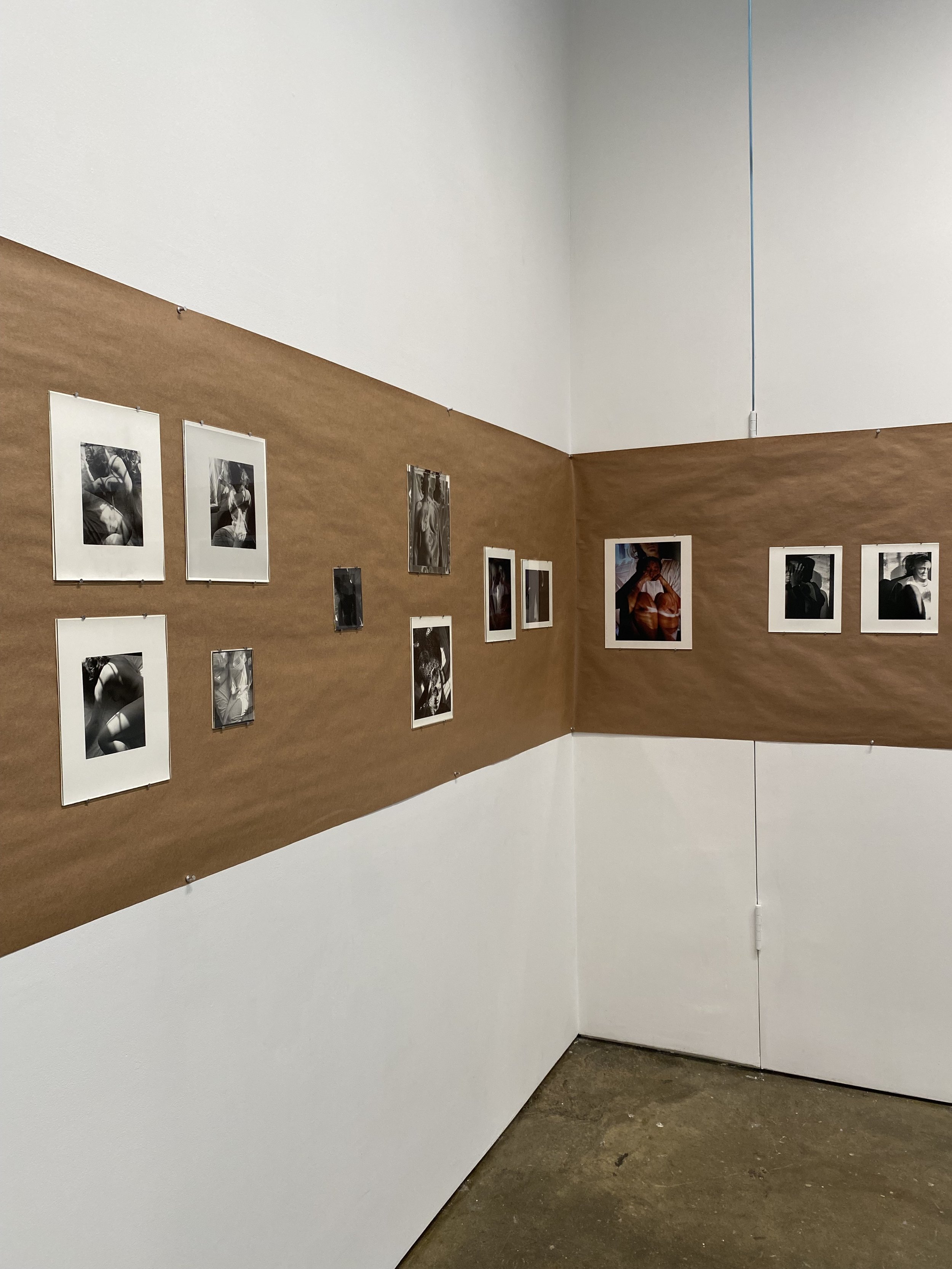
Carla Williams: Circa 1985 at Higher Pictures (Brooklyn, NY)

“I don’t remember when I first decided to take off my clothes for the camera. I know it was in that first year of photography classes, probably the first semester. The contact sheets showed me experimenting with stages of undress. Tights on. Tights off. Leg up. Smile. Wink. I figured I knew what to do, since I’d seen it played out for years. I never showed the pictures to anyone. They looked nothing like the magazines, but they sure looked like me, and I was thrilled. I was seeing exalted nudes every day in art history class, but I didn’t want to be Charis Wilson; I wanted to be Edward Weston and Charis Wilson in one. I knew I needed more technical sophistication, and that I had launched into something I hadn’t yet begun to understand. I put away those negatives and contact sheets for more than thirty years. But I kept photographing. And I never fully put my clothes back on.”

Carla Williams, Tender

Carla Williams: Circa 1985 at Higher Pictures (Brooklyn, NY)

Williams’ images are at once tender and wise, awkward and exhilarating. They reflect a young woman’s burgeoning sexuality and expansive curiosity about the medium. As a Black woman processing a canonical history that positioned so many models, girlfriends, and wives as muses to their photographic ‘masters,’ Williams did not see herself reflected in any of the history books’ most revered images. She was nevertheless absorbing a classic, timeless aesthetic of female representation.

(Higher Picture Press Release)

from wiki

A womanist is committed to the survival of both males and females and desires a world where men and women can coexist, while maintaining their cultural distinctiveness.

source

untitled

in a sea of stars

his galaxy stole the spotlight

in awe

she stood there

fixated

blinded by his halo

a gravitational pull

a universal force

she couldn’t escape nor did she want to

a galactic story written in the stars

an epic tale of two worlds colliding

to say she desired him was an understatement

she craved this reward

it consumed her entire being

written in 2019 (revised in 2021 and 2023 and 2025)